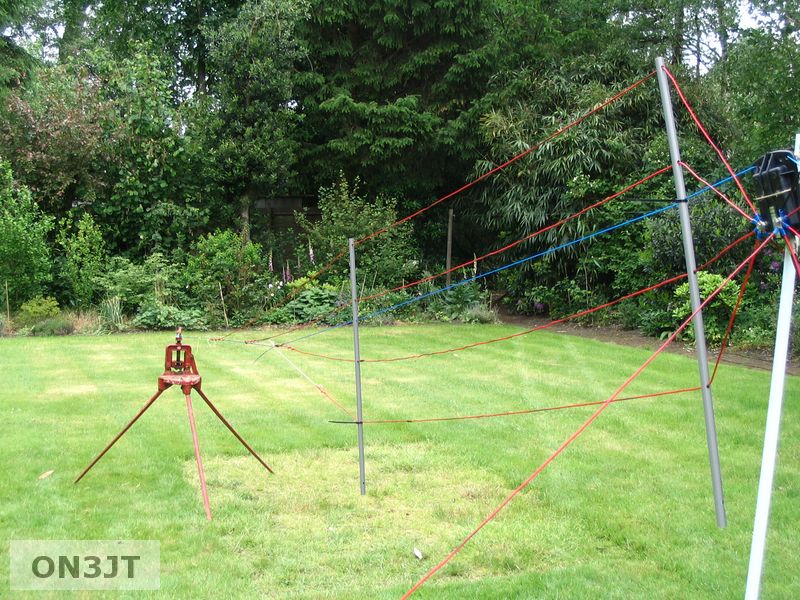
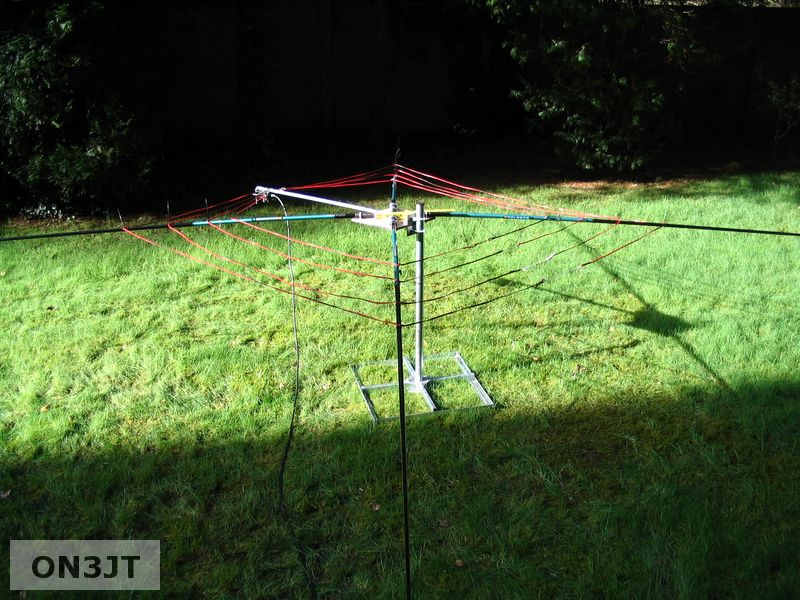
First I tried to build a Cobwebb antenna. It is a small antenna and rather easy to build. I used cheap fishing rods, costing 4 to 5 euro each, from a known sports hardware shop. The funny thing was when I asked the sales person if the rods contain carbon fibers he mentioned that I’m not the first asking. He says = “Some people use them to make antennas…”. Big smile when I replied to do the same. Bought speakerwire and started cutting and soldering. Finally the first dipole was attached to the big cross. Added in total 4 dipoles when I wanted to test it. It was a small disapointment. Only 400 kHz usable bandwidth on 10m. The 12m and 17m were usable. But 15m also lacked the necessary bandwidth. That, the mechanical instability and difficulties in triming each band was enough to stop this project.
Time for something else.
![]()
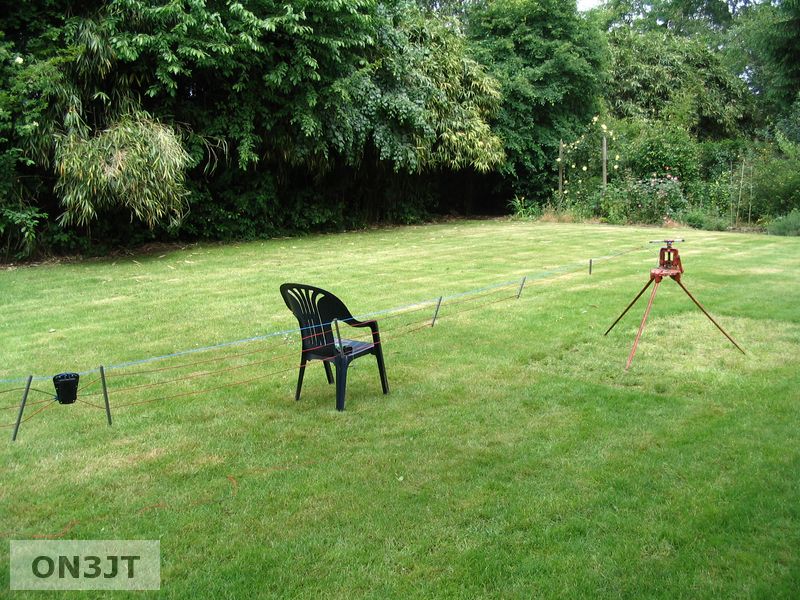
The next antenna built was a so called Fan Dipole antenna. 5 Wires parallel for each band, fed by a balun at the common center. I started with 10cm between each dipole. But the interaction between each element made it also difficult to tune. I figured out that I needed at least 15 cm between each element, the more the better. But also here not enough bandwidth on 10m. The test setup was a bit changed to a 4 band dipole with 1 inverted V for 10m, turned 90 degrees from the fan dipole. See the pictures. This works, but the weight of the balun and the span of the whole thing decided me to go for something else.
The vertical
I was already playing with an old CB-antenna. Removed the coil at the bottom, added 4 radials of a 1/4 wave at 20m and there it was. A groundplane antenna for the 20m band. Initial tests were good, nice flat swr response, good copy on dx stations, …
But when finishing the antenna a few weeks later I noticed that I couldn’t find the resonance point back. After hours of examening, testing, unscrewing, other bolts I found the “problem”. The antenna itself was mounted on a sat mount, 1m AGL. The radials were lying on the lawn. Elevated the radials with 1 meter so that the angle with the radiator was 90 degrees solved the problem.
Why not use more than one radiating element like a fan dipole ?
Searching the net for more info gave me lots of info about open sleeve antennas, close coupling and so on. There was a site grounding the other elements. The antenna looked like a small V. But not worked for me from the first time.
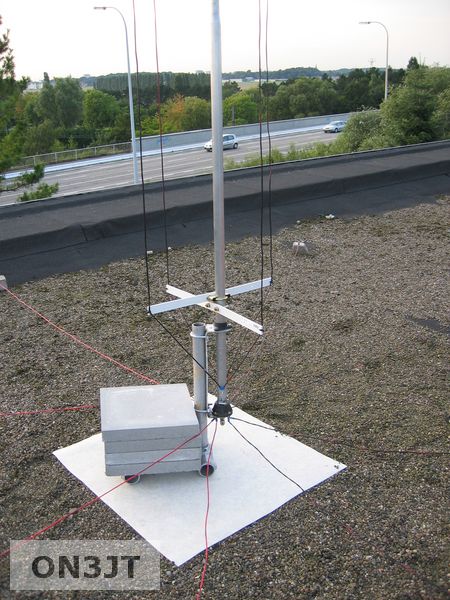
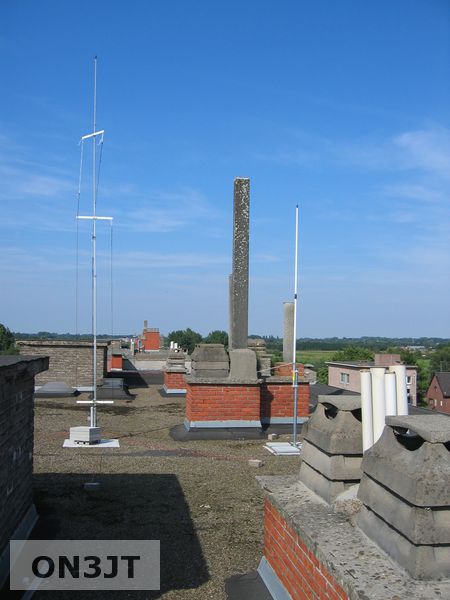
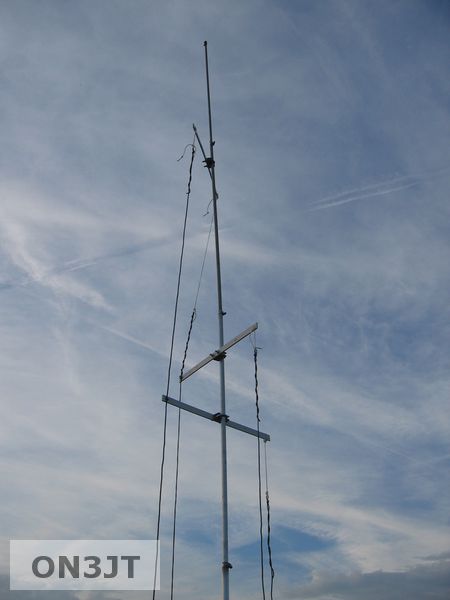
I cut 4 elements each a 1/4 wave at its band. Attached plastic spreaders to the CB antenna and hung up the 4 other bands. Drilled a hole nearly at the bottom of the antenna and connected all elements together. Look at the picture for more details. Still using the 4 radials of 5,2m (1/4 wave on 20m) the antenna was not usable. By accident I noticed when I rearranged the radials to a 1/8 wave on 20m everything worked. Instead of 4 radials of 5,2 m I now have 8 radials of 2,5 m.
So now I have 5 band vertical HF antenna without lossy traps, stubs, loading coils, ….
A 1/4 wave on each band that already survived two small storms. Ok, it tipped over but no harm done.
Entries (RSS)
April 24th, 2008 at 13:57
Hi there!
Did you try the cobwebb on a higher mast? It’s no wonder if it didn’t work on the height in the picture. The ground effect is huge at those heights. So far what I’ve read, the cobwebb acts quite similar to an dipole, so it’s should have wider BW than what you measured.
I’m building one by myself too and gonna soon do some testing with VNA.
Cheers,
73 de Janne, OH1GTF
April 24th, 2008 at 17:17
Unfortunatly not. Never thaught about that.
A normal halfwave dipole at the same height gave me better results in bandwidth. I asked a Dutch ham to share me his findings but helas. Maybe I’ll build another one, beside the elements itself, everything has a place in the garage.
Thanks for the idea. Joost
PS Visited your site, looks very nice. One project not mentioned in my projects list is a magnetic loop, a 3×3 meter square. It’s huge
I think I’ll reduce it to 2×2 meter. Plan is to use it horizontal.
April 25th, 2008 at 07:32
Great to hear that you haven’t abandoned the CobWebb design!
I’m not sure, but I think that CobWebb might be quite tricky at too low heights hence the bent element and
that’s the reason why dipole at the same height has wider BW.
Magnetic loops are great! I have been testing them quite a much. The first version was D of 1 meter with a DIY variable capacitor made of two aluminium plates and glass between them as an dielectric. The range was from 40m to 10m.
I’ve also build two magnetic loops for 2 meters and they both work really well! Also the 80m loop seem to work a lot better than I expected. Just two weeks ago I took around 500km and 600km fone QSOs and the antenna was inside.
Just drop me a note when you build something again. It’s great to see another experimentist.
73 de Janne, OH1GTF
April 25th, 2008 at 09:43
I agree that magloops are great. Built one for listening and was my first experiment with magloops, details can be found on my old site : http://on2bbp.byze.be/projects/magnetic-loop-antenna.php
).
Also made one like G4FON (www.g4fon.net) described. Used that one for transmitting and made some nice qso’s in psk31 on 20m. Used it indoors near the window. Built a protoype of a variable capacitor, alu elements were laser cut. Cost was higer then expected, about 60 euro. Next time I use stainless steel if the cost is reasonable (I think not
Forget a magloop in the garage, copper square, 60cm sides, but with a trombone capacitor. Is now eating dust. Never finalised it.
I like to built, theory is not that important for me, and test is, then up to the next experiment. An example : my first antenna on this QTH was a 1m tall helical wound antenna for 20m. The radial was a 1/4 wave. It worked, but it is nothing compared to a full size antenna. If I find a picture of it in my archive, I’ll post it online.
Keep building and experimenting HI.
73 Joost ON3JT
Currently designing and building a shortened 40m dipole, coils are wound. Article about that is in draft status.
April 25th, 2008 at 10:54
Joost,
You can always drop me an email if you want to share your experiments (can be found at my web pages). There isn’t too much builders around so I’m a big ear for you
And BTW, I’m pretty much interested about the theoretical side and even more interested how theory and practice
go hand in hand. Antenna simulators like 4NEC2 etc. has proved that antennas can be simulated amazingly well!!!
Good moments with antenna testing/building for you!
73 de Janne, OH1GTF
April 25th, 2008 at 22:29
Hey Guys,
I too have built a cobwebb, and placed it in my loft (rented property, cautious XYL = no outside aerials hi hi)
I haven’t tuned it as yet, or tested bandwidth, however, it is kind of resonant in the right place (slightly low on each band) I currently tune it with a manual ATU to bring it into band, but it isn’t performing as I would have hoped – I can work around Europe locally, but I rarely hear stations at more than S5!! On occasion I hear weak signals from the USA on 14Mhz, but as for working them, not a chance!
I am not sure if this is due to the type of wire I used for the elements (cheap, thin speaker wire) or whether it just does not like being indoors under slate tile!
I had a look at building a mag loop, but gave up on the idea due to the mechanical complexity of tuning it remotely! I have a nice variable capacitor liberated from an old clock radio, so might have a go at pinching a “hula-hoop” from my nephew to use as a guide for the large loop and use a faraday loop for the small loop and see where that gets us for a QRP/Rx only loop!
Anyway it is nice to see people discussing antenna building in open forum like this, particularly people who have built/considered the same designs I have!
Best 73
de Tony
G0WFV
April 27th, 2008 at 13:35
Hi Tony,
I’ll keep this short because I’m in the lobby of a hotel in Oostend. Enjoying a weekend with the XYL and no kids
There is a another G-station using the CobWebb, his plans I used. I emailed him for his experience with the antenna, but never received a reply. When I am at home I’ll search the site again.
About tuning a magloop : I have an idea/project based on the circuit of an ATAS120 antenna. 8 Volt for forward and 12 volt for backwards turning.
73 Joost.
April 30th, 2008 at 12:38
Found the link back. I remembered that it was an aol.com site. But that’s history now. But I do find things back in Google
The site can now be found at http://www.g0mtd.co.uk His plans were used to build mine. You guys raised my interest to rebuild my cobwebb again. I also found a site of a german ham who also complains about bandwidth, but he rebuilt it to a 3 band version, less interaction between the dipoles.
And now I remember that there was a ham not that far from my location that also built one, but used relays for bandswitching instead of a common feedpoint. Don’t know if he still uses that antenna.
April 30th, 2008 at 13:10
Actually, I have a system on my multiband GP which I designed, that controls the bands with relays controlled through the coaxial cable.
I also have thought about using relays instead of common feed point. It will null out the interaction problem totally.
It is of course more complex system, but the electronics can be fitted inside the same size enclosure than the original feedpoint system has.
73 de Janne, OH1GTF
April 30th, 2008 at 13:28
I looked at the page of G0MTD about the cobwebb and found one think that I’d do differently. He uses a huge amount of aluminium in horizontal as supports for the arms. It is really bad because those arms will absorb the horizontal radiation and will detune the antenna and might also be the cause for the narrow bandwidth dilemma.
The original cobwebb uses only two small aluminium plates to keep it all up. I think there’s a reason for this.
I just received the wire I ordered for the cobwebb. Now for buying for four fishing rods. I will attach one band at a time to adjust the resonances and T-matches. After it’s all done, I will add the relays.
73 de Janne, OH1GTF
April 30th, 2008 at 13:34
I used a some type of wooden plate, not really weatherproof but good enough for testing. Keep us updated.
73 Joost
May 1st, 2008 at 00:49
Hi,
do you pick up lots of manmade noise with GP?
Was Cobwebb more quiet?
73, Mart
May 1st, 2008 at 07:31
Hi Mart,
I really can’t tell. The Cobwebb has never reached the roof so side by side comparision is never done. I hope that Janne OH1GTF can bring an answer if his cobwebb is finished. I’m pretty shure his is finished before I have rebuilt mine
The next problem is that I don’t have any other antennas to compare with, I find the GP pretty good with normal noise levels. But what is normal if you can’t compare….
Joost
May 9th, 2008 at 19:01
Keep plugging away at the CobWebb, Joost! I found it to be quiet on the bands it is resonant on (considering I live in the town centre!), and it’s such an easy antenna to construct, but I think I’ve been a bit too tight with my money and constructed it with inferior wire (only 7 strand speaker wire instead of 42!!) I think at some point I will stump up the extra cash for a 50m roll of 42 strand Fig8 cable!
Just out of interest to you guys, I used 4 x 3m telescopic windsock masts for the spreaders (available from http://www.kiteshop.co.uk/xcart/outdoor-fun/wind-spinners/telescopic-pole_p912.html for £2.99 each – approx €3.75) I unscrewed the endcap and remove the last 1m (or so!) telescopic element leaving you with the perfect 2m (ish!) spreader for a CobWebb! (the 4 x 1m sections have since been used to construct a bodged up 2m Moxon!)
As my antenna was always going to be in the loft, it is held together with cable ties and the centre cross is two pieces of wood screwed together at right angles, with holes drilled in them and the winsock masts cable tied in place through the holes! Simple, effective, and strong enough for indoor use where wind is not going to be a problem! The feedpoint box is resting on an old kitbag!
Tony
May 18th, 2008 at 16:25
Tony, do you want to use better cable because you want to use more power or it is better for reception also?
May 26th, 2008 at 14:29
The current antenna system is deaf! I am unsure weather this is due to location or construction. As I can do little about the location, I can alter the construction so as to be sure I have kept to the original CobWebb spec as possible.
June 20th, 2008 at 21:30
I have just found your site and was particularly interested in your multi-band vertical. I came up with a very similar solution about a year ago and the details can be found at http://g7aqk.uk.googlepages.com/Fantenna.pdf . I have improved the initial design by running a single 1/4 wave counterpoise horizontally for each band in addition to the earth connection. Bandwidth is OK for most of the bands but only covers about 500KHz of 10m.
Neil
June 20th, 2008 at 21:49
Hi Neil,
I just measured the bandwidth on 10 again. The 2:1 points are 28.603 and 29.607. My initial readings a year ago were more in the neighbourhood of 700 to 800 kHz (for what I can remember) . Strange effect
What about using 2 wires on 10 ? One tuned to 28.000 and the other to 29.500. I never tried it but who knows ? Or a alu tube instead of a wire ?
I see that you have a ground stake, I don’t have one on my roof, but it seems to be working.
June 20th, 2008 at 23:54
I tuned up the antenna initially using just the counterpoise and it matched reasonably well. Attaching the earth improves things marginally but not much. I did find that trimming the length of the counterpoise for minimum SWR was much easier than adjusting the length of the radiator. The counterpoise wires run along the fence approx 150-300mm above the ground. The earth is connected to a 4 ft earth rod and the metal fence spikes supporting the boundary fence. I might try the two wire suggestion or even use two counterpoises of slightly different lengths.
Neil
August 1st, 2008 at 07:15
Real good info on antenna my friend thanks for sharing. Hope to see u on air ……………….73
de VU2SGW clear
August 12th, 2008 at 13:01
I made a similar vertical a few years ago using a fishing pole with wires held around it. It was mounted on the side of a house with elevated radials and it worked very well. It was only for three bands, 10m 15m 20m.
Gordon
GM4SVM